Polar Opposites Attract on Titan

Polar Opposites Attract on Titan

As a scientist, it is a good feeling to come across something that contradicts textbooks. Better still to contribute to a discovery that could help explain chemistry on a  planetary – or should I say moon-etary – scale! This post is about a paper published in the Proceedings of the National Academy of Sciences in which Fernando Izquierdo Ruiz, Álvaro Lobato and I teamed up with Morgan Cable, Robert Hodyss, and Tuan Vu at NASA’s Jet Propulsion Laboratory to study surprising molecular interactions that may take place on Saturn’s moon Titan. Lots to unpack here.

First, any basic chemistry course will tell you that polar and nonpolar compounds do not mix. Yet in this article, we combine data from cryogenic experiments with quantum mechanical calculations to show that hydrogen cyanide, HCN – a molecule more polar than water – can form co-crystals with methane and ethane, two of the most nonpolar substances known. At sufficiently low temperatures, these molecules defy conventional chemistry! They manage this feat because the HCN crystal is differently structured in different directions. In it, all the highly polar (and very toxic) HCN molecules line up in neat hydrogen-bonded chains, reaching from one end of the crystal to the next. Between these (polar) chains are nonpolar cavities, where small nonpolar molecules such as methane and ethane can enter (Figure 1).
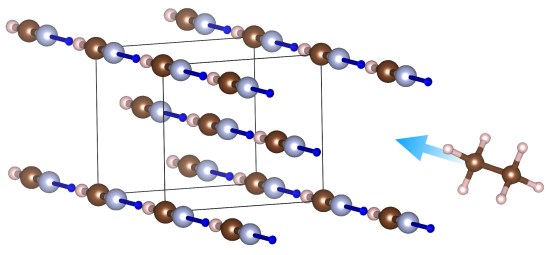
Figure 1. The low-temperature mixing of nonpolar hydrocarbons with HCN – a molecule more polar than water – breaks conventional chemical expectations.

So why care? Well, beyond reshaping our understanding of molecular compatibility at low temperatures, this discovery matters because HCN and small hydrocarbons are abundant on Saturn’s moon Titan.

Titan is a special place: it is a moon larger than the planet Mercury, and it is the only other body in the solar system besides Earth that features liquids on its surface, lakes and seas, even rainfall. Two oh-so-slight differences from Earth are that the surface temperature is a frigid 90 K (-180 ℃) and that the seas and lakes are not made of water but predominantly methane and ethane. Titan is also enveloped by a yellow haze of organic (i.e., carbon-based) molecules of unknown composition. The haze is formed through complex atmospheric chemistry that is driven by radiation brought by Saturn’s colossal magnetosphere, as well as the Sun. Foremost among the products formed in the atmosphere is HCN – there are even clouds of it!

HCN, in turn, is super fascinating, as it has been shown to readily react to form many of life’s building blocks, such as nucleobases and amino acids. While toxic to humans, by evolutionary accident, it is likely essential for the formation of life as we know it, and maybe for other kinds as well. All this to say: Titan is a truly alien place on which unintuitive chemistry far from Earth-ambient conditions governs!

Our discovery that some of the most abundant molecules on Titan can mix intimately, on the molecular level, may therefore help explain not just prebiotic chemistry, but also the physical evolution of Titan’s surface. Better yet, we may find out in a few years!

Figure 2 shows Dragonfly, an SUV-sized nuclear-powered autonomous quadcopter, set to launch from Earth in 2028. Yes, this engineering marvel is by any metric very cool. If all goes well, it will make landfall on Titan in 2034, and begin studying its surface chemistry for signs of life.
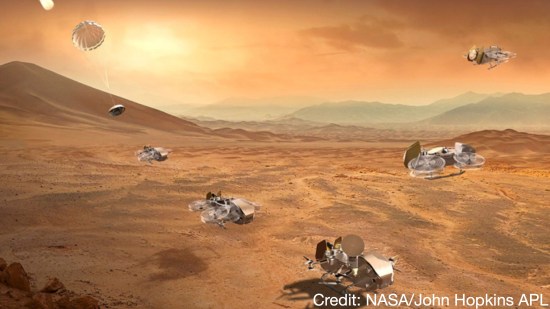
Figure 2. Saturn’s moon Titan is due for a visit by Dragonfly, which will study its surface chemistry and look for signs of life.

I hope our work, and its greater context, will inspire more scientists, young and old, to look beyond the familiar world of ambient conditions. There is so much left to uncover about what transpires in more extreme environments, whether at the high pressures created by an impact, at the center of a planet, inside a diamond-anvil cell, in the heat and acidity characteristic of our neighboring planet Venus, or, like on Titan, at cryogenic temperatures.

Some who read this might ask: why work on such ethereal stuff, so far detached from our very real challenges here on Earth? To those I would like to share my philosophy of science: when we learn to understand extremes, our challenges at ambient conditions pale in comparison. Or, as Roald Hoffmann once paraphrased:

“The fringes are more than the frame; they define the center.”

Finally, I will admit to my main reason for writing this post: it is to emphasize just how interdisciplinary and downright awesome chemistry – the central science – can be. Learn it, and you might discover many secrets on this world and beyond.

– Martin, September 28, 2025

P.S. The paper “Hydrogen cyanide and hydrocarbons mix on Titan” is behind a paywall for the first six months. You can find an earlier free preprint here.

A Quest for the World’s Most Energetic Compound

A Quest for the World’s Most Energetic Compound

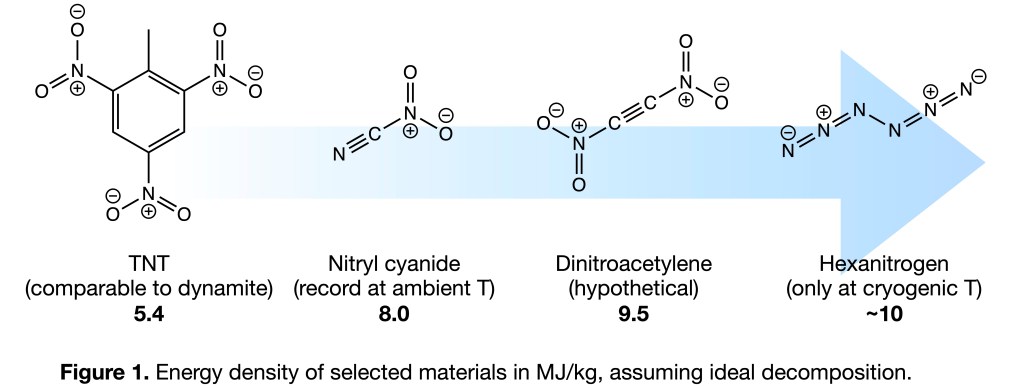
In a recent article, Lara Harter and Guillaume Belanger-Chabot (both at Université Laval in Quebec) and I computationally investigate the feasibility of making dinitroacetylene (C2(NO2)2; see Fig 1). If synthesized, this compound would be the most energy dense chemical ever made that remains persistent at ambient conditions. It would release about 9.5 MJ of heat for every kilogram combusted into CO2 and N2. That is a lot. It is possible that the only way to cram more chemical energy into a material is to make a nitrogen allotrope, such as the still hypothetical N4.

Indeed, you might have read about the recent, impressive synthesis published in Science by Qian et al. of N6 — two azide groups stitched together to form a linear chain of nitrogen. That compound is, at least to the best of my knowledge, more energetic than anything (non nuclear) in existence. However, N6 is also stupendously prone to decomposition into N2 and can only persist at cryogenic temperatures.

Our recent theory paper on dinitroacetylene is a good example of Swedish–Canadian partnership in research, and highlight a fascinating target for molecular engineering and design. But in this day and age, its publication also made me reflect on the reasons for pursuing such materials in the first place. How does one get tangled up into the pursuit of the world’s most energetic compounds?

When I began my scientific career as a PhD student in 2006, it was a different time, to say the least. War and conflict felt largely delegated to history. As an avid space nerd, I took on a challenging project aimed at developing a more environmentally friendly rocket propellant based on ammonium dinitramide, NH4N(NO2)2. The goal was to help replace the toxic perchlorates still used in heavy space launchers. It was rocket science, and the perfect project for someone eager to work hard and learn a lot, but couldn’t quite decide between pursuing theory or experiments, academia or industry. I soon found myself working simultaneously in quantum, polymer, inorganic, and analytical chemistry.

This rather unique PhD experience was, ironically, made possible by the project being severely underfunded. The research was designed for, and clearly required, two PhD students to succeed: one focused on theory and another on experiments. But only one was funded! This situation turned out well for me, as I ended up doing the work of two and learning more than I could have imagined. Not because anyone pressured me, but because I found the research stimulating, loved learning, and worked in an environment that was supportive and above all trusting. I wish that more young researchers could benefit from growing by experiencing such freedom under responsibility. But that is another topic altogether.

My PhD thesis Green Propellants covers not only theory and experiments on ammonium dinitramide and polymers, but predictions of several unknown materials. The crowning achievement was arguably the successful nitration of dinitramide, making N(NO2)3, the world’s largest nitrogen oxide. My PhD advisor Tore Brinck and I jokingly called N(NO2)3 a ”propeller propellant” due to its C3 symmetry. While a very potent oxidizer, this molecule (like N6) decomposes above -20C and is of no real use besides academic curiosity.

Later, during my first postdoc with the (I dare say legendary) Karl Christe at the University of Southern California, Guillaume and I managed to make something considerably scarier: nitryl cyanide, NCNO2. This compound currently holds the record for energy density of compounds persistent at ambient conditions, sporting 8 MJ/kg. It took about three years to synthesize and characterize. I bring that up to make a point: the reason we were able to persist for so long was that I had convinced myself (and Guillaume) using careful quantum chemical calculations that NCNO2 really could be made. Theory also gave us the vibrational spectroscopy bands to look for, and which nuclear magnetic resonance signals that would confirm its presence.

Many others must have tried to make NCNO2 before us, the structure is so simple. But without knowing that a pursuit is possible, there is less reason to persist. Persistence is often needed to advance science, and ours was well motivated!

So why did I decide to pursue trinitroamine and nitryl cyanide, compounds that most chemist would tell you cannot be made? Mostly, I wished to learn about the limits of chemical bonding – how much energy one could squeeze into electronic configurations of matter before reality objected. My motivation was curiosity.

While energetic materials are fascinating for pushing the boundary of chemical possibility, they are also useful in everything from road construction to beautiful (if often environmentally questionable) fireworks to lifesaving air bags, and space flight. However, their usage these days is increasingly military. The ethics of the latter is more complex than most admit. Personally, I find it unethical for a democracy like Sweden not to maintain a well-functioning defense. Of course, to be useful, a military needs be well equipped. And you see where this is going: whomever have the better propellants fire and fly longer. Developing or producing such materials, then, is not inherently unethical – in fact, it can be quite the opposite.

It is in this light that I was just stunned to find that, as of this posting, my PhD thesis has been downloaded 7185 times. That is not normal for a PhD thesis, and worrying for I suspect that those downloads are not motivated by a great need for environmentally friendly access to space, or non-toxic fuels for satellite navigation, but low-signature propulsion.

Publishing advances in the field of energetic materials in the open literature can, in some cases, raise ethical concerns. At the same time that is true for many fields of study, where outcomes can have multiple uses. For what it is worth, I hope that the share of my scientific work that deals with energetics will prove more inspiring, helpful and interesting, than harmful.

If I ever feel obliged to give up my passion for astrobiology and chemical bonding to pursue energetic materials full time, most of us will have bigger problems than publication ethics to consider. For in such a situation, the work would not be published. It would be ethically applied.

— Martin, July 23, 2025

A Theory of Food Evolution

A Theory of Food Evolution

During the holiday season I got reminded of an idea I sometimes bring up jokingly (usually after a few drinks): A theory of food evolution! It goes something like this:

Food is an evolving story of culture, survival, and adaptation. Akin to how species evolve, recipes adapt to different environments, and evolve under different pressures, including cultural preferences, global trends, and scientific advances. The evolution of food mirrors the very processes that drive life itself!

But could food evolution be more than a metaphor or silly analogy? Could it be a real framework with predictive power, capable of explaining trends, extinctions, and innovations? I think so. And I will even be so bold as to make some predictions before this post is over! After all, a theory that does not make testable predictions is not worth much.

The survival of the tastiest, the healthier, or the more affordable?

Recipes as Genetic Code, Ingredients as Genes

Imagine recipes as the genetic code, the blueprint for creating a dish. Ingredients are the genes, determining the flavor, texture, and nutritional profile of the food. And just like in biology, the final product – the dish – results from a combination of the recipe, ingredients, and cooking methods (akin to gene expression). In other words, we can make the following analogies:

1. Recipes = Genetic Code

The recipe is the blueprint for a dish, much like DNA is the genetic code that determines the structure and function of an organism. Recipes are passed down, sometimes adapted, but are always central to the outcome.

2. Ingredients = Genes

Ingredients are the building blocks of a dish, akin to the genes within DNA. Changes to the ingredients, such as substituting meat for tofu or adding a new spice, are like genetic mutations that affect the final product.

3. Cooking Techniques = Gene Expression

The way ingredients are combined and prepared (boiled, baked, fried) determines how the “genes” are expressed. The same ingredients (genes) can produce vastly different results based on the technique (gene expression) – for example, a raw tomato vs. a roasted one.

4. Dish = Organism

The finished dish is the “organism” resulting from the recipe, ingredients, and cooking method. The dish reflects the interactions of its components and the environment in which it was made.

The Survival of the Tastiest?

Like organisms in nature, dishes face pressures that shape their evolution over time. What are they?

While taste is arguably important, it’s far from the only factor that determines whether a dish thrives. Here are a few more:

  • Cost. Economic constraints often drive adaptations of recipes. Ingredients that are expensive or scarce are replaced with affordable alternatives. For example, during times of scarcity, margarine became a cheaper alternative to butter. And in many regions of the world, street food developed as a cost-effective way to feed working populations.
  • Convenience. Modern lifestyles prioritize speed and ease. This makes convenience a powerful driver of food evolution (more so than taste?) Recipes that once required hours of preparation are now simplified. Think for example of instant ramen noodles, or frozen ”ready-to-eat” meals (yuk).
  • Health. Changing dietary preferences and health concerns can have dramatic influence on food evolution. Think for example of how gluten intolerances has spurred the developments of alternative versions of bread, pasta, and so much more (including, importantly, beer).
  • Ethics. Changing ethical considerations are clearly reshaping the culinary world, influencing everything from sourcing to production. Take for example the rise of vegan plant-based meat alternatives, or lab-grown meat.
  • Globalization. The blending of cultures is not as much an evolutionary pressure in itself , but a facilitator that has led to a rapid exchange of recipes, techniques, and ingredients, driving the creation of hybrid dishes. Sushi burritos, or Swedish kebab pizza are examples of hybrid dishes that show how globalization creates new culinary niches. The latter example is an Italian dish evolved by immigrants from the balkans and the Middle East. The dish share several ingredients with the döner kebab, itself invented by a Turkish immigrant to Germany.
  • Technology. Technological advances have been pushing the boundaries of what’s possible in food production and preparation since the dawn of history. More recent examples include the use of artificial intelligence to analyze flavor combinations and create entirely new dishes, and the development of 3D-printed food.

Predictions!

With a theory in hand, we can apply the identified evolutionary pressures (and undoubtedly others not yet listed) to make some food forecasts. For brevity’s sake I will limit this post to a few favorite predictions (what are yours?).

1. Space-Based Food

As a space nerd, I’d be remiss not to highlight that thanks to plummeting launch costs, we are likely at the cusp of a booming space economy. More people than ever before will work, and periodically live, in space. This development effectively creates a new environment for food to adapt and evolve in. I say new because historically, space food has been primarily prepackaged, dehydrated, and likely not overly appetizing. Launching ready-to-eat meals is also expensive. These are evolutionary pressures in favor of food production and preparation in space!

One obvious challenge is how to bake a pizza in zero G. Imagine trying to keep pizza toppings in place while the dough floats around! Might this be solved by the rise of spinning space ovens that use centrifugal force to simulate gravity? If you happen to start manufacturing such ovens after reading this, please remember who gave you the idea – I’d like a cut of the profits!

Other expected developments are algae-based meals, nutrient-dense dishes, and dishes relying on hydroponic farming systems. Cooking in zero gravity is sure to spark innovations, leading to entirely new species, pardon me.. recipes!

2. Automated Cooking of Personalized Food

I think the combined evolutionary pressures of convenience, technology, and health will inevitably result in artificial intelligence being coupled increasingly to cooking robotics. Yes, that will be used to make loads of unhealthy stuff. But combined with individual health tracking and knowledge of (ordinary) genetic profiles, this development is also likely to lead to recipes tailored specifically for your body!

3. Extinctions

Just as most species that ever existed have gone extinct, many human made dishes have as well been forgotten, or fallen completely out of use. How many that are lost is perhaps an active topic of research in a culinary sub-discipline of historiography? As this blog post is my sole endeavor into the topic of food history, I can but speculate that we are trailing biology and that there are more recipes alive today than ever before. But I do have concrete predictions for a few of those that will go extinct in the near future.

Basically all not-at-all-tasty “traditional” cuisine that we silly humans consume exclusively during select holidays hang on by a thread. The Swedish grisfotsaladĂ„b (pigs feet in jelly – it is not an attractive form of nutrition!) is a prime example of dish definitely on the critically endangered list. My grandfather was the last one in our family to insist on its making. I predict it will be gone globally within a generation, and no more than two. Of course, no prediction is perfect. Maybe a gallant rescue operation will delay this particular inevitability slightly.

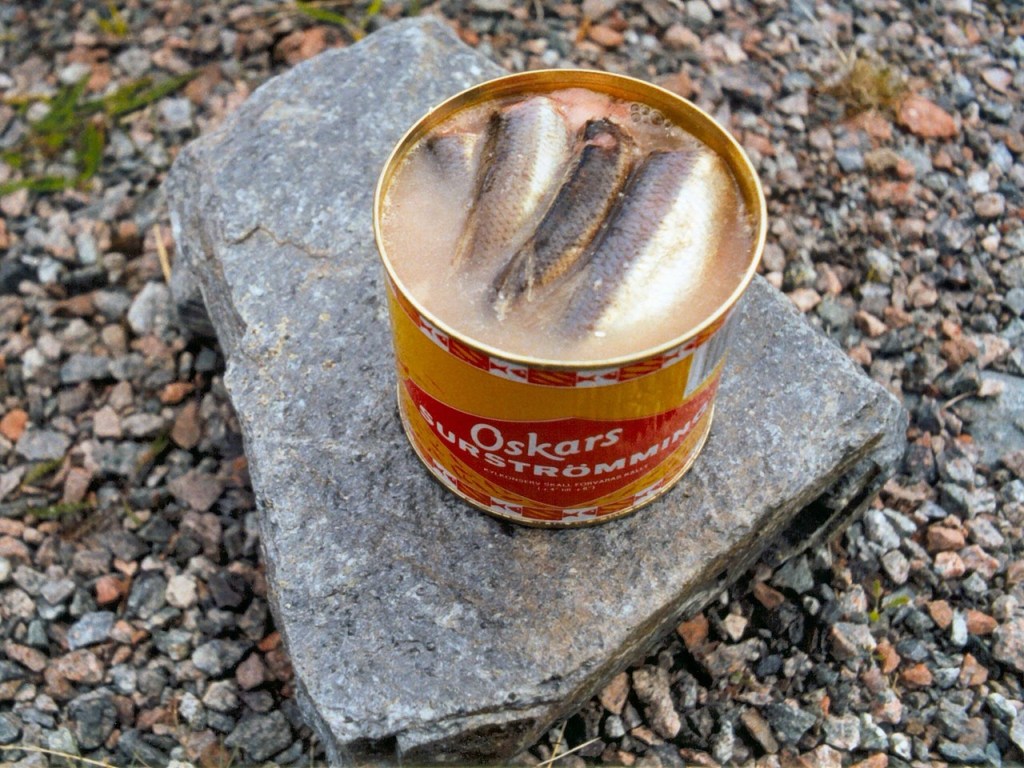
Other dishes within the same general category (from Scandinavia) includes lutfisk, rehydrated whitefish that takes on a gelatinous feel, and surströmming, fermented herring in a jar that smells like evil and that contains enough toxins to merit a special European Union exemption allowing its continued legal existence.

Surströmming, fermented fish in a jar. A case study of survival against all odds and reason. Source: Wikipedia

On second thought, while the grisfotsladÄb and lutfisk are done for, surströmming might well stand eternal as long as there is a Swede alive in the universe. I suppose human civilization will insist on saving a few recipes out of pure principle, consequences be damned.

Food Evolution, A Real Theory?

A serious theory or not, I have found this idea offering a new way to think about the meals we eat, remember and create. I think food evolution is a real process with implications for culture, sustainability, and even survival. As such, this theory, perspective, call it what you will, can help us better connect with our past, understand our present and make educated guesses about our future. What do you think?

— Martin, January 4th, 2025

(idea evolved about 6-7 years earlier)

Feedback welcome on social media!

A Current-based Currency To Save Our Climate

A Current-based Currency To Save Our Climate

The world would clearly benefit from abundant access to carbon-neutral electricity. However, a significant obstacle lies in the basic economics of supply and demand. As electricity production increases, prices drop, which can periodically lead to sharp declines in investment for new power generation. This post explores a potential solution that could help make electricity inexpensive enough to enables transformative changes across industry, transportation, and everyday life.

Imagine a currency tied to carbon-neutral energy production. Here’s how it might work: if you contribute something that generates power to the grid without emitting CO₂—like solar panels on your roof, a share in a wind turbine, or a nuclear reactor—this new currency is created and awarded to you as that source produces electricity. The more carbon-neutral electricity you generate over time, the more currency you earn. Crucially, the reward is not tied to selling electricity, which remains tradable using conventional money. Instead, the currency is awarded purely for enabling carbon-neutral electricity production.

A current-based currency to boost carbon-neutral energy production

The only way to create more of this energy-backed currency (perhaps it could be called “power coins” or “e-coins”?) is to actively contribute to increasing or sustaining carbon-neutral, or even carbon-negative, electricity production.

This system could leverage technologies developed for cryptocurrencies but, in stark contrast to most, would mitigate environmental damage rather than exacerbate it. Unlike cryptocurrencies that depend on energy-intensive digital mining, this currency’s “mining” process would require the creation of sustainable electricity production—a tangible utility in the real world.

Tying a currency to carbon-neutral energy production would be a modern equivalent of the gold standard. Historically, monetary systems relied on gold reserves, an approach that eventually fell out of favor for several reasons. For one, the finite supply of gold limits governments’ ability to respond flexibly to economic crises. Moreover, gold—like many currencies and cryptocurrencies—is largely useless in practical terms. Its value stems from a mix of scarcity and shared human narratives, rather than from inherent utility.

In contrast, an energy-based currency would enable economies to “print money” by bringing more carbon-neutral electricity production online—something inherently useful.

The concept lends itself to a range of possible implementations. It could be adopted by national governments, much like a conventional currency; by decentralized communities, akin to a cryptocurrency; or by international organizations and non-profits acting in the public interest. Each model offers distinct advantages and drawbacks, and scaling up any of them introduces practical hurdles. For example, how can we reliably validate the energy production of “miners”? What kind of technology and regulatory frameworks would ensure trust and fairness? These are questions to solve. In what follows, I will address a few other, different questions.

  • Who decides the wattage-to-coin exchange rates?

Ultimately, the market does. While the currency’s supply is tied to production of carbon-neutral electricity (as in the gold standard analogy), its relative value against other currencies would float. Traditional currencies rely on government backing, while many cryptocurrencies function like speculative assets or stocks. This new currency would represent a different kind of money—one whose supply is anchored in real-world power production (the literal ability to do work), but whose exchange rate still depends on market forces. It would be subject to speculation like any currency, yet remain grounded by a tangible, renewable resource.

  • Why not just rely on subsidies to increase the desired electricity production?

Subsidies are often short-term fixes for long-term challenges, and many do not survive more than a single election cycle. By weaving the incentives to solve the energy crisis directly into our monetary system, we give them a better chance to endure, persisting long after fleeting political priorities fade.

  • Will lack of control and continuous mining of this currency not cause high inflation?

At the very beginning, it might appear that inflation could run high, as the currency grows rapidly from a very small base. However, this initial phase is more akin to starting from zero and ramping up production capacity than a persistent inflationary spiral. Over the longer term, it’s helpful to compare this system to how governments manage conventional currencies. By setting interest rates, central banks target inflation at around 2–4%. Notably, this range aligns closely with the average growth in global electricity demand (2.4% in 2022, 2.2% in 2023, and a projected 3.2% through 2026). Although this similarity doesn’t guarantee a direct causal link, it reflects how electricity demand—and by extension, industrial productivity—tends to grow at a relatively steady pace. Because it takes time to bring new generation capacity online, a current-based currency can’t simply inflate without limit. It may not be regulated in the traditional sense, but it can still be guided. For instance, reducing power plant output effectively throttles the inflow of currency to the market. Conversely, if the economy needs stimulation, both electricity generation and currency supply can be increased together. In this way, the currency and energy production remain intertwined, maintaining balance rather than runaway inflation. Taxation could serve as an additional lever, allowing states to fine-tune the amount of currency in circulation and help maintain overall stability.

  • Countries will never give up their own currencies, so why would this ever be realistic?

In practice, this idea can scale organically. It could start within a small community of enthusiasts, grow to serve as an auxiliary currency for a nation or region, and potentially evolve into a global standard. History shows that countries can abandon their currencies when offered a compelling alternative—for example, the European nations’ move toward a shared currency after World War II.

Before dismissing this idea, consider the alternatives. Conventional money exists only because of collective trust in a government, while speculative cryptocurrencies often demand enormous computational resources—using significant amounts of non-carbon-neutral electricity—to solve meaningless math problems. Surely, a currency tied to something real and beneficial, like carbon neutral electricity, makes more sense.

If you know someone interested in making this idea a reality, share it with them—and let me know what you think.

— Martin, December 7, 2024

(This idea was dreamt up about two years prior. But I’ve been busy—you know how it goes.)

Feedback welcome on social media.

Welcome Rana!

A belated welcome to Rana Doǧan, an undergraduate student who joins us remotely from Boğaziçi University in Turkey. Rana is helping us to explore the prebiotic chemistry of hydrogen cyanide, while learning about computational chemistry.

Welcome Marco and Werner!

Marco Cappelletti and Werner Dobrautz has joined the group! Marco joins us from the University of Milan to pursue a PhD. He will work on astrochemistry and the challenge of understanding HCN polymerization. Werner joins us as a postdoctoral researcher from the Max-Planck-Institute for Solid State Research in Stuttgart. He will work on enabling quantum computation of chemistry in collaboration with IBM-Zurich.

Welcome Siddhant!

Siddhant Sharma has received a Chalmers Astrophysics & Space Science Summer (CASSUM) Research Fellowship, and joins us as an undergraduate summer student from the University of Delhi! He will work on astrochemistry and the challenge of understanding HCN polymerization.