Computational Astrobiology and Prebiotic Chemistry
What is the molecular basis of life, and how did life originate? These are fundamental questions that ultimately will involve systems of extreme complexity. To help evaluate which initial chemistry might have given rise to such complexity, we are studying one of the Universe’s simplest and most ubiquitous molecules.
Hydrogen cyanide, HCN, is believed to be a key ingredient for prebiotic chemistry, and a versatile building block for the construction of biomolecules. However, the chemical structure of HCN-based polymers remains an open question. There are significant challenges associated with the characterization of polymeric HCN, and highly complex mixtures of soluble and insoluble materials are typically generated in laboratories.
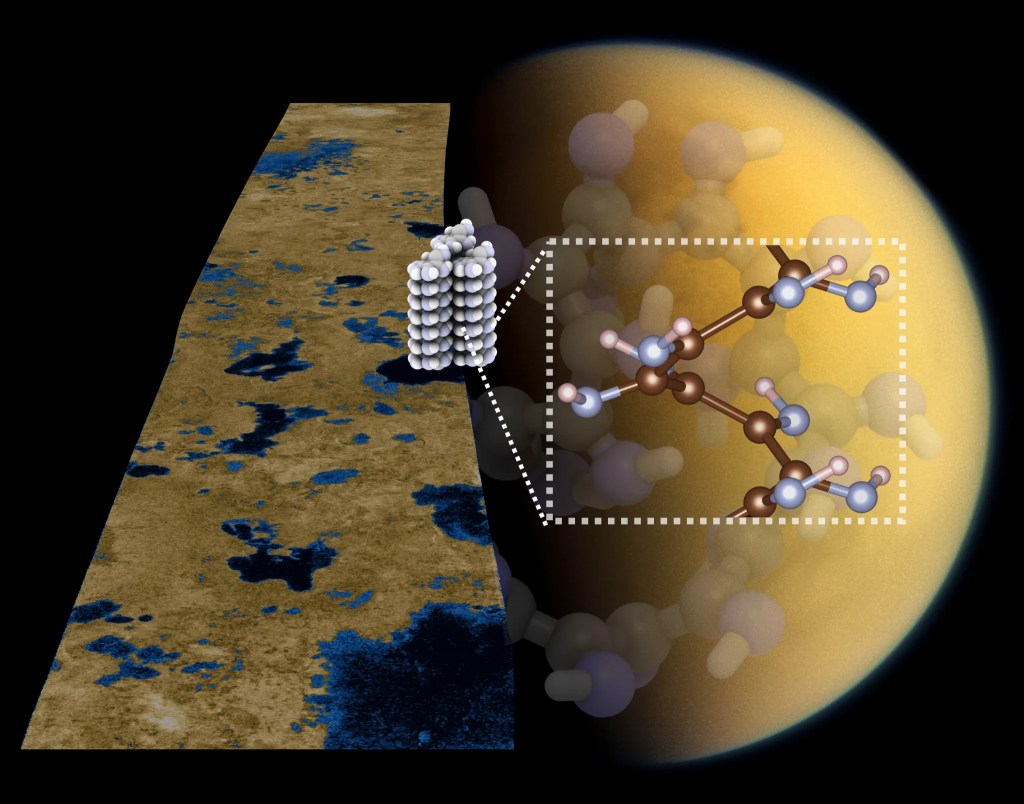
To tackle this challenge, we are using a combination quantum chemistry and theoretical condensed matter physics methodology to explore well-defined HCN-based materials and polymerization mechanisms. It is possible that such structures might form under kinetic controlled conditions (low temperature) and over long time-scales. To evaluate how HCN chemistry plays into observations we are collaborating with planetary scientists, whose particular focus is Saturn’s moon Titan. Titan can, in some respects, be considered a frozen over version of the early Earth, and the former provides a natural laboratory for studying prebiotic chemistry occurring under cryogenic conditions. One of the most abundant products of Titan’s atmospheric chemistry is HCN, where it contributes to the formation of not yet well-understood photochemical hazes.’
Research Highlights:
- How Does Adenine Form from Hydrogen Cyanide?
Marco Cappelletti, Martin Rahm
J. Am. Chem. Soc, 148, 4, 3949–3961, 2026 - Electric Fields Can Assist Prebiotic Reactivity on Hydrogen Cyanide Surfaces
Marco Cappelletti, Hilda Sandström, Martin Rahm
ACS Central Science, 12, 1, 111–121, 2026 - Hydrogen cyanide and hydrocarbons mix on Titan
Fernando Izquierdo-Ruiz, Morgan. L. Cable, Robert Hodyss, Tuan H. Vu, Hilda Sandström, Alvaro Lobato, Martin Rahm
Proc. Natl. Acad. Sci. U.S.A. 122 (30) e2507522122 2025 - On the possibility of carbon-free heteropolymers on Venus: a computational astrobiology study
Ishaan Madan, Shekoufeh Arabi Aliabadi , Johanna Huhtasaari, Ebba Matic, Emil Hogedal, Kinga Kamińska, Filip Nilsson, Axel Stark, Fernando Izquierdo-Ruiz, Hilda Sandström, Martin Rahm
QRB Discovery, 6: e23, 1-11, 2025 - Crossroads at the Origin of Prebiotic Chemical Complexity: Hydrogen Cyanide Product Diversification
H. Sandström, M. Rahm
J. Phys. Chem. A.,127, 20, 4503–4510, 2023 - Can Polarity-inverted Membranes Self-Assemble on Titan?
H. Sandström, M. Rahm,
Sci. Adv. 6, eaax0272, 2020

